
Case study: Johan Lindahl, Framgångsrik Försäljning I Sverige AB
Background
Johan Lindahl runs Framgångsrik Försäljning i Sverige AB, where he works closely with management teams and sales groups within different sectors.
Johan Lindahl holds a Master of Science degree in Behavioral Science with a specialization in Psychology.
Photo: Eva Lindblad, Tusen & en bild
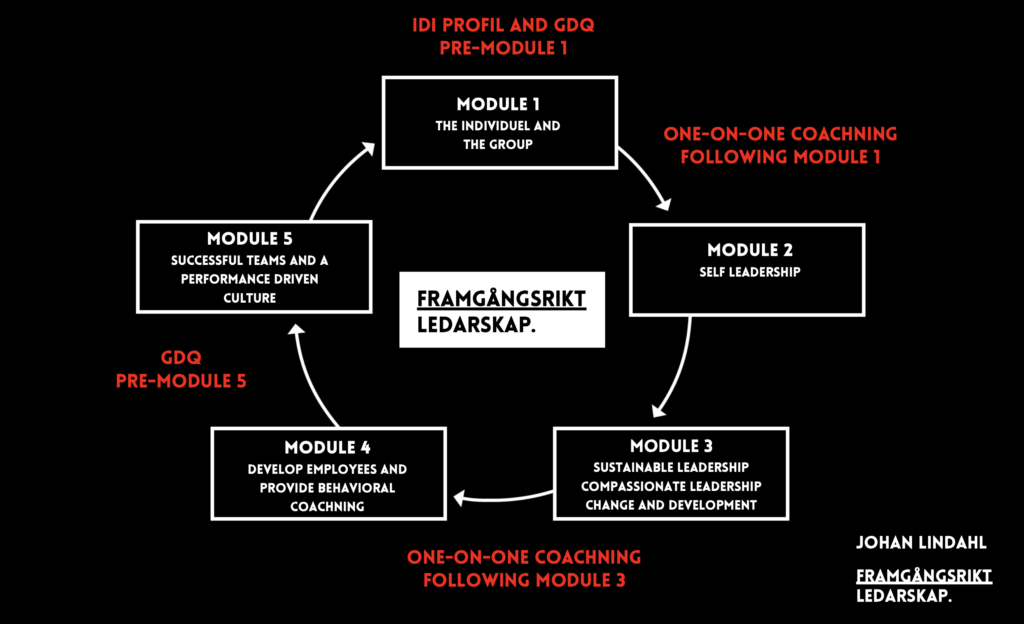
Since 2015, Johan Lindahl has been one of Sweden’s most sought-after speakers in leadership, sales, and team development. He has worked with over 400 different organizations and completed nearly 1900 training assignments. GDQ has been a central component of Johan’s leadership program, Successful Leadership, which consists of five training modules and two days of individual coaching.
Why did Johan choose to work with GDQ?
“GDQ is a fantastic tool. It’s research-based and helps team members understand where they believe they are in their group development process.”
For Johan, the strong research foundation behind GDQ makes it a credible and obvious choice. He also highlights how easy it is to understand—both the theory and the results—which makes it highly usable in practice and helps the groups develop.
Over the years, Johan has conducted GDQ assessments with more than 60 groups. He sees the GDQ as a powerful way to map team dynamics and create a clear snapshot of how a group is functioning.
“It makes things visible. It puts into print what everyone already knows—but hasn’t always said out loud.”
The process
Johan works with a five-step programme where the GDQ is used both at the beginning and at the end.
The first step is a GDQ assessment to map the team’s current stage of development, combined with individual reflection and one-to-one coaching. This creates a shared understanding of how the team functions and how individual behaviours contribute to the whole.
The middle steps focus on self-leadership, role clarity, sustainable and caring leadership, change and development, and how to develop people and coach based on behaviour. The group explores motivation, energy, stress, and everyday behaviours, while also strengthening their ability to coach with presence, care, and clarity—focusing on behaviours rather than solely on results.
The programme ends with a follow-up GDQ measurement. In Johan’s experience, this always shows a clear movement toward a later stage of group development. The results are reviewed in a simple and transparent way, using norm data, stage descriptions, subscale analysis, and open dialogue to strengthen trust and psychological safety.
Results
When leadership teams move to a later stage of group development, the change is clearly noticeable. Communication becomes more open, engagement increases, and collaboration feels easier.
“You can feel it in the room. You see it in how people talk and how they relate to each other,” says Johan.
And what can be felt in the room is reflected in the data measured by the GDQ. In Johan’s experience progress does not happen automatically over time. Real development comes from actively working with trust, self-leadership, psychological safety, and behavioural change—supported by insights from the GDQ.
Key insights
Successful teams are built on clarity, trust, and psychological safety. Teams need a shared understanding of why they exist, what they are working toward, and how roles, responsibilities, and decision-making are defined. Just as important is having clear ways of working with feedback and follow-up.
Trust is created in everyday interactions between people. It grows when actions are consistent, communication is open, and team members feel they can rely on one another. Psychological safety builds on this foundation, enabling people to speak up, challenge ideas, and show up as themselves without fear of negative consequences.
The GDQ provides a research-informed way for teams to create a shared picture of where they are and what needs to be developed. It helps make priorities visible and gives teams a common language for discussing trust, psychological safety, and collaboration. From there, insights can be translated into concrete, observable behaviours that teams can work with in everyday practice—making development both practical and actionable.